




// Help center
Your questions, answered.
Clear, straight answers about our hyperbaric oxygen chambers — from choosing a model and getting a quote to installation, safety, warranty, and long-term service.
No matching questions. Try another word — or ask us directly.
// Products & models
Products & models
What does hyperbaric mean?
Hyperbaric is a technical term for a pressure condition above normal atmospheric pressure. It comes from the Greek hyper (above) and baros (weight, pressure), so it literally means “above normal pressure”. Its opposite is hypobaric. A cabin counts as hyperbaric as soon as the pressure inside it is higher than the pressure outside.
What is a hyperbaric hyperbaric oxygen chamber?
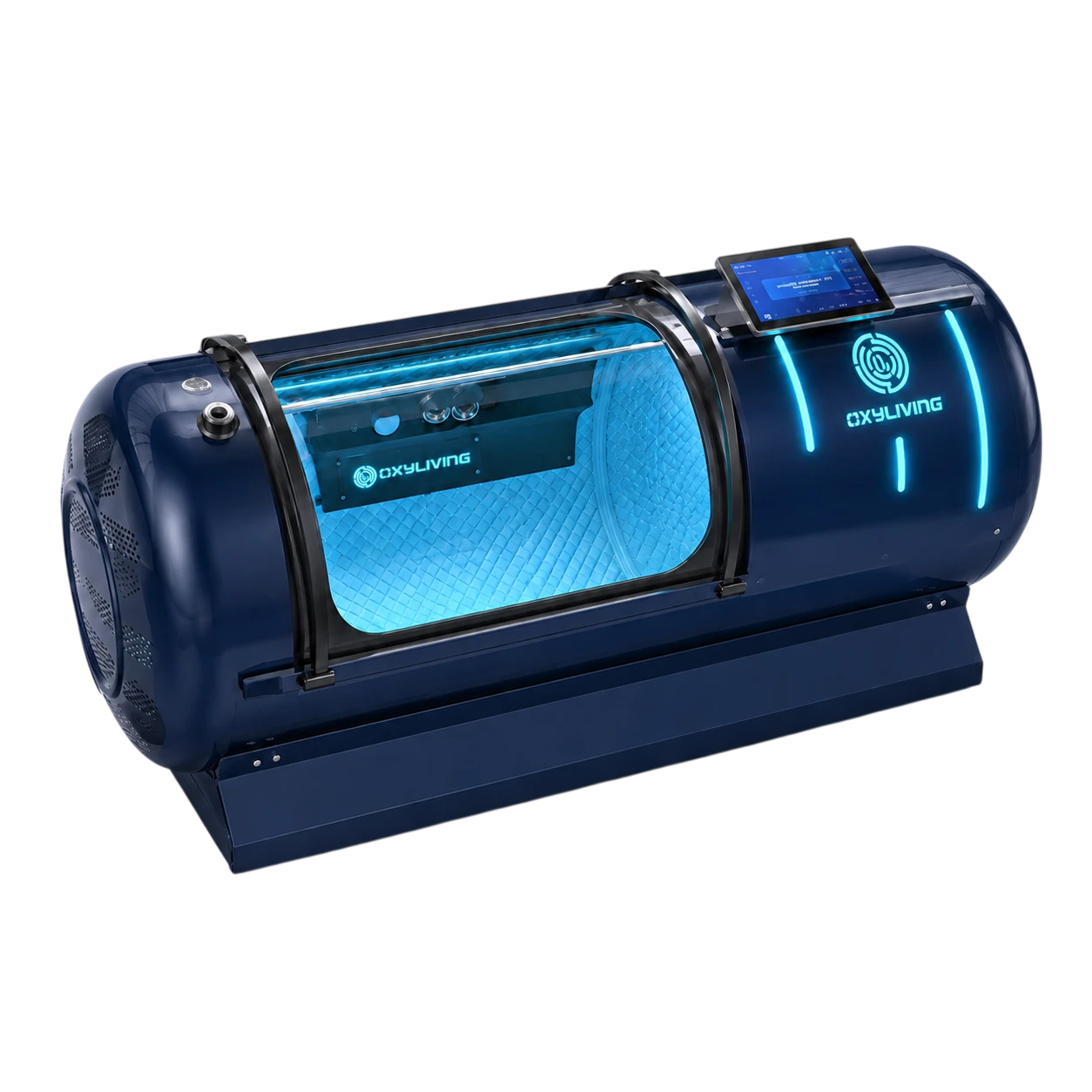
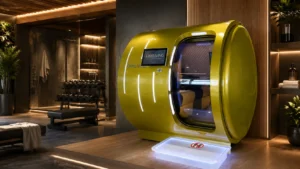
A hyperbaric oxygen chamber is a sealed cabin that raises the pressure inside it above normal sea-level pressure while supplying oxygen-enriched air. Oxyliving chambers run at up to around 2 ATA — twice sea-level pressure — and generate roughly 93% oxygen on site, so no cylinders are needed. Models range from single-seat capsules to 14-person rooms.
How does a hyperbaric oxygen chamber work?
In three stages. An oil-free dry compressor raises the pressure inside the cabin gradually. A built-in concentrator then draws oxygen from ambient air to roughly 93% purity and delivers it through a mask or cabin feed. At the end of the session the pressure is brought back down just as gradually. The whole cycle is monitored and controlled from an operator panel outside the chamber.
How much does a hyperbaric chamber cost?
Oxyliving chambers are built to order, so there is no fixed list price. Cost is driven by capacity (single-seat up to 14 people), cabin type, interior upholstery and colour, optional equipment, and the installation site. For a figure against your own specification, use the quote form and our team will come back to you.
What is the difference between a monoplace and a multiplace hyperbaric chamber?
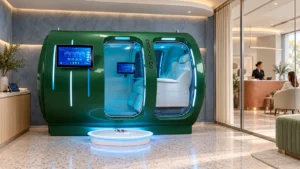
Both work on the same principle; the difference is scale and how they are used. A monoplace chamber holds one person and is compact enough for a home, showroom or small studio. A multiplace chamber holds four to fourteen people, is walked into rather than climbed into, and is designed for institutional installations. In the Oxyliving range Avicenna and Cezeri are monoplace; Taragay and Biruni are multiplace.
What models does Oxyliving offer?
Our range goes from single-person capsules to multi-place systems — Cezeri, Avicenna, Farabi, Taragay, and the multi-place Biruni — alongside an integrated oxygen generator and accessories. You can compare them all on our products page.
How many people can use a chamber at the same time?
Anywhere from one person up to around fourteen, depending on the model. Single and two-person models suit homes and wellness centres, while larger multi-place systems like Biruni are built for hospitals.
What's the difference between a single-person capsule and a multi-place chamber?
A single-person capsule is compact and ideal for personal, wellness, or showroom use. A multi-place chamber seats several occupants at once and is designed for higher-throughput institutional settings, with an operator managing each session from outside.
What pressure do the chambers operate at?
They're engineered to operate at elevated pressure — up to approximately 2 ATA, depending on the model and configuration — using a silent, oil-free dry compressor system.
What are the chambers made of?
The body is built from 5083 aircraft-grade aluminium, with a flat floor you can step onto, an acrylic viewing window, and a non-flammable, easy-to-clean interior finish backed with foam padding on the sides and ceiling.
What's included as standard?
Every chamber includes the compressor and automation system, internal and external monitoring displays, an in-chamber tablet and TV unit, a fire-retardant interior, configurable seating, on-site oxygen generation at 20 L/min per person, and oxygen masks.
What optional extras are available?
Options include an in-chamber gaming system, a red-light system, and advanced seating with heating, cooling, and massage. Custom finishes and accessories can be added when you configure your order.
// Ordering & pricing
Ordering & pricing
How do I get a price?
Tell us about your space and what you need, and we'll prepare a tailored proposal — model, configuration, lead time, and pricing — with no obligation. Start on our request a quote page.
How quickly will I hear back?
We respond to every enquiry within one business day (Monday–Saturday, 08:00–18:00 GMT+3).
How long does it take from order to a working chamber?
Typically around 8–12 weeks end to end — from the first conversation through manufacturing, delivery, and on-site commissioning. See the full breakdown on our order process page.
Can I order just one unit?
Yes. We build to order for individual buyers as well as facilities, hotels, and distributors — single units included.
Do you sell and ship internationally?
Yes. Oxyliving chambers are installed in more than 20 countries, and we handle logistics and on-site installation worldwide.
// Customization
Customization & configuration
Can I customise the chamber?
Yes — every chamber is engineered to order. You choose the finish and colour, upholstery, controls, seating, and accessories before production, and we confirm the final specification together.
What seating options are there?
Seats slide and adjust automatically, with a reclining option and footrest. Heated, cooled, and massage seating is available, and we can produce custom seats on request.
Can you build to a special requirement?
In most cases, yes. Because we design and manufacture in-house, we can adapt configurations, finishes, and certain features to your project — just tell us when you request a quote.
// Installation & delivery
Installation & delivery
Do you deliver and install the chamber?
Yes — it's a complete handover, not a drop-off. Our own team handles delivery, placement, assembly, connection, and on-site commissioning. Full details on the installation & delivery page.
What do I need to prepare before installation?
A clear access route and final location, a power supply to specification (we confirm it), adequate ventilation, a level load-rated floor, and an on-site contact for delivery day. You'll receive a full site checklist after ordering.
How much space does a chamber need?
It varies by model, so we provide a technical drawing for each one to help you plan the space precisely. Chambers sit on a flat floor and can be positioned in a standard room.
Will it fit through a standard doorway?
In most cases, yes. Where a fully assembled unit won't fit, we pass the parts through doorways of at least 80 cm and assemble the chamber inside the room.
Can the chamber be moved or repositioned later?
Yes. The lightweight aluminium body sits on wheels, so it can be repositioned indoors without major effort.
What power and water connections are required?
Standard mains electricity and water, using jack-type connections. Inside the chamber, a low-voltage 24V DC system is used for safety, and no special technique is needed to connect it on site.
// How it works
How it works
Where does the oxygen come from?
An on-site oxygen generator produces oxygen by filtering the air in the room — so there's no need to keep buying oxygen tanks. The system can also connect to a hospital's central oxygen supply or to cylinders where preferred.
How is oxygen delivered to the user?
Through a BIBS mask system that supplies oxygen as you breathe in — around 20 L/min per person at roughly 93% purity. A Free Flow mode is also available for continuous delivery during a session.
Does the compressor run the whole time?
No. The silent, oil-free dry compressor runs only while the chamber is pressurising — storing air in a stainless-steel tank — then stops once the set pressure is reached.
Is the air refreshed during a session?
Yes. The system performs automatic ventilation every 10–15 minutes to maintain air quality, and the operator can ventilate manually at any time. An optional CO₂ sensor can trigger ventilation automatically.
What can the operator see and control?
Internal and external displays show session time, pressure, oxygen purity at the mask, oxygen level inside the chamber, humidity, and temperature. The operator controls lighting, ambient colour, cooling, and more — and the interior panel can be locked for safety.
// Safety & monitoring
Safety & monitoring
How is the oxygen level kept within safe limits?
Oxygen is delivered to the mask, not released into the cabin, so the chamber air stays around 20–22% oxygen. If it ever reaches 27%, an automatic safety system ventilates and releases air to keep conditions safe.
What sensors and monitoring are built in?
Two oxygen sensors run continuously — one measuring oxygen at the mask, one measuring oxygen inside the chamber — both shown in real time on the operator screen. A CO₂ sensor can be added on request.
What happens if the mask is removed during a session?
The user simply breathes the chamber's ambient air, which stays at around 21% oxygen — the same as normal room air.
What safety features are built into the structure?
A non-flammable interior and cabling, a low-voltage 24V DC system inside the chamber, an automatic decompression system, and continuous monitoring all work together for safe operation.
// Warranty & service
Warranty & service
Is there a warranty, and what does it cover?
Yes — every chamber ships with a manufacturer's warranty covering the structural body and pressure vessel, seals and core mechanical parts, control units, sensors, and electronics, plus warranty labour and remote support. See warranty & service.
What isn't covered by the warranty?
Accidental or impact damage, unauthorised modifications or repairs, normal-wear consumables such as filters, and use outside the operating guidelines.
How do I get service or maintenance?
We offer scheduled maintenance, genuine spare parts, and direct technical support — remote help first, on-site when needed — from the same team that built and installed your chamber.
How often do the filters need replacing?
The chambers use 0.1-micron filters with roughly 1,000 hours of active working life. Replacement is covered by your service schedule.
How do I clean and disinfect the chamber?
The interior is easy to wipe down, the BIBS masks detach for cleaning, and a UV-light option is available. Nitrogen cleaning can also be applied on request.
// Certifications & company
Certifications & company
What certifications do the chambers carry?
They're built to recognised pressure-vessel and quality standards — including BS EN 13445-2, ISO 9001, ISO 14001, ISO 45001, and ISO 3834-2 — and carry CE marking for machinery and equipment.
Are the chambers built to high standards?
They're built with high-grade certified components, and every chamber is built to recognised pressure-vessel and quality standards and carries CE marking for machinery and equipment.
Can I become a distributor or dealer?
Yes — we work with sales representatives, distributors, and dealers worldwide. Learn more and apply on our become a distributor page.
Do you provide training?
Yes. Operator training is included at handover, with on-site and online options. See our training programs page.
Where is Oxyliving based?
Our chambers are designed and built in-house at our facility in Kocaeli, Turkey. Oxyliving is part of Tesan Global Mühendislik.
// Still have a question?
Can't find what you're looking for?
Tell us about your space and we'll point you to the right answer — or prepare a tailored quote.